
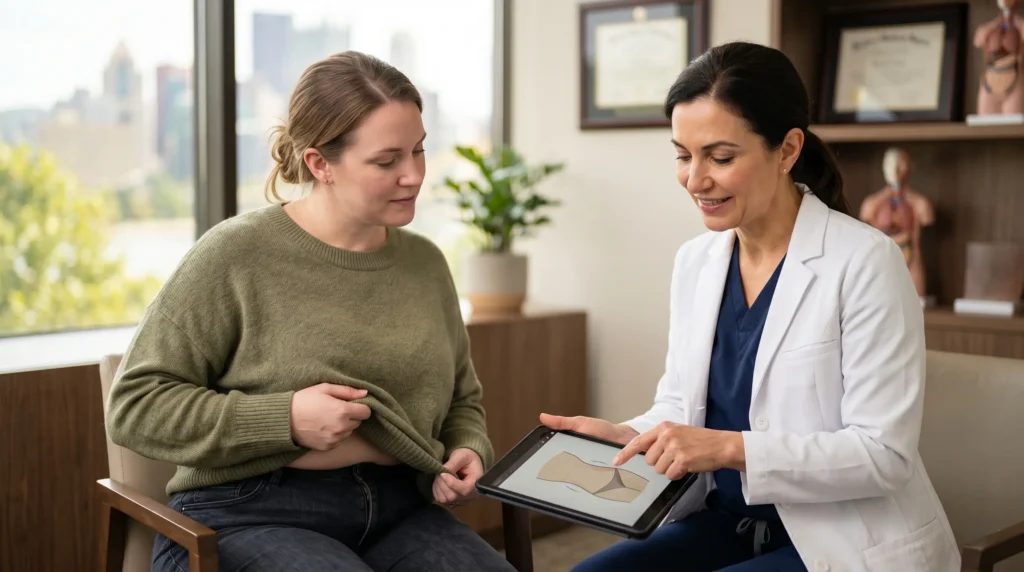
GLP-1 medications like Ozempic®, Wegovy®, and Mounjaro® have changed the weight loss conversation in a big way. Patients are losing significant amounts of weight faster than ever before, often after years of struggling to see progress. But according to Pittsburgh plastic surgeon Dr. Simona Pautler, many patients are surprised by what comes next: loose, hanging skin that doesn’t bounce back with the weight loss.
“You can’t exercise skin away,” she explains. “When you touch the back of a cat or dog, you can see their entire back twitch, right? That’s because they have muscles in their skin that humans don’t have.” Once human skin stretches beyond a certain point, especially after years of weight fluctuations or rapid GLP-1 weight loss, it often loses the ability to retract on its own. “We’re left with the skin we have,” she says honestly. “At that point, surgery is really the only thing that removes it.”1
That is why more patients are asking about excess skin removal after medical weight loss. The goal is not to erase the work it took to lose weight. The goal is to address the skin and soft tissue changes that can remain after the body size changes.
Why GLP-1 Weight Loss Can Leave Loose Skin Behind
When patients lose a substantial amount of weight, especially in a relatively short period of time, the skin often cannot keep pace with the body’s changes. Age, genetics, smoking history, pregnancy, and how long the skin remained stretched all play a role in how much loose skin develops.
Skin is living tissue, but it is not elastic in the same way that a waistband is elastic. If it has been stretched for years, or if weight changes happen quickly, the collagen and elastin support within the skin may not be able to retract enough to match the smaller body contour.
Patients commonly notice sagging in areas like:
- The abdomen
- Upper arms
- Inner thighs
- Breasts
- Face and neck
- Back and buttocks
For many people, these areas become frustrating reminders of their former weight, even after all the hard work of losing it.
Exercise can improve muscle tone, strength, posture, and overall health, but it cannot remove extra skin. Skin care, energy-based treatments, and non-surgical options may improve mild texture or laxity in select patients, but they are not designed to remove significant folds of hanging skin.
“Ozempic Face” Is Only Part of the Skin Laxity Conversation
One thing Dr. Pautler has noticed is that patients often focus heavily on facial changes after GLP-1 weight loss. Hollowing in the cheeks, jawline laxity, and neck sagging have become so common that social media coined the phrase “Ozempic face.” But in reality, she says the entire body can be affected.
Facial changes may lead some patients to consider a facelift or neck lift, especially when weight loss reveals jowling, skin looseness under the chin, or a less defined jawline. But the same principle applies throughout the body. Once volume is reduced, the skin envelope may no longer fit the underlying shape.
This is why a consultation after GLP-1 weight loss often needs to look at the whole picture, not just one isolated area. A patient may come in to discuss the abdomen, then realize that the arms, breasts, thighs, or neck also changed as the weight came off.
Surgical Options After GLP-1 Weight Loss
The good news is that there are surgical options to address these concerns. Depending on the patient’s goals, Dr. Pautler may recommend procedures such as:
- Tummy tuck
- Arm lift
- Thigh lift
- Breast lift
- Facelift or neck lift
- Back lift or lower body contouring
Many patients also combine procedures to improve multiple areas at once and streamline recovery.
The right plan depends on where the loose skin is located, how much tissue needs to be removed, whether weight has stabilized, the patient’s health, and how much recovery time is realistic.
Tummy tuck for abdominal skin laxity
Tummy tuck surgery can be helpful when loose abdominal skin remains after weight loss, pregnancy, or weight fluctuation. In some patients, the concern is mainly lower abdominal skin. In others, the laxity may extend above the belly button or around the waist.
A tummy tuck is different from weight loss. It is a contouring procedure that removes excess skin and can improve the shape of the midsection once the patient is already at or near a stable weight.
Arm lift, thigh lift, and body lift options
An arm lift may be considered when the upper arms have hanging skin that does not improve with exercise. A thigh lift may help when inner thigh laxity affects contour, comfort, or clothing fit. A body lift may be appropriate when looseness involves the lower abdomen, hips, buttocks, or circumferential lower body.
These procedures are especially individualized because each area moves differently. The thighs, for example, must allow comfortable sitting, walking, and bending. The back and lower body may involve longer incision planning to improve contour across a broader area.
Breast lift, facelift, and neck lift after weight loss
After significant weight loss, the breasts may lose volume and sit lower on the chest. A breast lift may help reshape and reposition the breast tissue by removing extra skin. In the face and neck, weight loss can make laxity more noticeable along the cheeks, jawline, and under the chin.
Some patients benefit from focusing on one area first. Others may be better served by combining procedures if it can be done safely. The consultation is where the priorities, staging, scar placement, and recovery plan are discussed in detail.
When to Consider Excess Skin Removal After Weight Loss
Patients considering surgery after GLP-1 weight loss should usually be close to a stable weight and able to maintain healthy habits before moving forward. Ongoing major weight loss can change the surgical plan, because additional skin laxity may develop after surgery if more weight is lost.
It may be time to discuss surgical body contouring when loose skin:
- Interferes with clothing fit or comfort
- Creates folds that are difficult to manage with hygiene or skin care
- Makes exercise or movement uncomfortable
- Causes the body shape to feel out of proportion after weight loss
- Remains despite strength training, stable nutrition, and time for the body to adjust
- Affects the face, neck, arms, abdomen, breasts, thighs, back, or buttocks in a way the patient wants evaluated
A surgical consultation is not a commitment to surgery. It is a way to understand what is possible, what is realistic, what the scars may look like, and whether surgery should be done now or later.
What to Know About GLP-1 Medications Before Surgery
Dr. Pautler also emphasizes that GLP-1 medications themselves can affect surgical safety. These medications can slow stomach emptying, which is one reason surgeons and anesthesia teams ask detailed questions about timing, dose changes, side effects, and recent digestive symptoms before elective surgery.
“The food literally stays in your stomach longer,” Dr. Pautler explains. “And with anesthesia, if there’s a chance there could be food in your stomach, there’s a risk of aspiration.”2
Older guidance often told patients on weekly GLP-1 injections to stop the medication one week before elective surgery. More recent multi-society guidance has shifted toward individualized risk assessment, and many patients may be able to continue GLP-1 medications before surgery when their anesthesia team determines it is safe. Patients at higher risk may need additional steps, such as a temporary liquid diet, medication timing changes, or other precautions. Everyone is a little different. With longer procedures, which most of these surgeries are, sticking to the older guidance is what Dr. Pautler prefers.
That is why patients should not stop or continue these medications on their own. The safest plan is coordinated among the surgeon, anesthesia team, and prescribing clinician, especially for patients using GLP-1 medications for diabetes, cardiovascular risk reduction, or medically supervised weight management.
A safe surgery starts with honest conversations and careful planning. Patients should be transparent about all medications, supplements, dose changes, digestive symptoms, weight changes, and medical conditions before surgery.
Dr. Pautler’s Strategic Approach to Body Contouring
Body contouring after massive weight loss is not just about removing excess skin. Dr. Pautler approaches these procedures thoughtfully and strategically, often combining surgeries in ways that reduce operating time, minimize blood loss, and limit the number of recoveries a patient has to go through.
That strategy matters because post-weight-loss surgery can involve more than one body area. Combining procedures can be efficient for some patients, but it must be balanced against safety, operative time, blood loss, healing demands, and the patient’s ability to recover well.
In practical terms, a surgical plan may consider:
- Which area bothers the patient most
- Which areas can safely be treated together
- Where scars can be placed as discreetly as possible
- Whether the patient is still losing weight
- Medical history, smoking history, medications, and healing risk
- How much help the patient will have during recovery
- Whether staging procedures would be safer or more realistic than doing everything at once
The Tradeoffs Patients Should Understand
She’s also realistic about tradeoffs. Excess skin removal surgery often involves long scars. Recovery takes patience. Swelling and soreness are normal. But for the right patient, the improvement in comfort, confidence, clothing fit, and body proportions can be life-changing.
The key is understanding the exchange. Surgery can remove skin that diet, exercise, and time cannot remove. In return, patients need to accept incision lines, healing time, activity restrictions, swelling, and the gradual nature of final results.
The most satisfied patients are usually those who understand both sides of the decision. They are not expecting surgery to create perfection. They are looking for a more comfortable, proportionate, and finished result after a major weight loss transformation.
A Personalized, Honest Approach to Excess Skin Removal
Patients considering surgery after GLP-1 weight loss are often already proud of how far they’ve come. Dr. Pautler sees body contouring as the final step in helping their appearance match the work they’ve already put in.
Every weight loss transformation is different, and your surgical plan should reflect your anatomy, goals, lifestyle, medication history, and recovery needs. Whether you are considering a tummy tuck, arm lift, facelift, thigh lift, or a combination of procedures after GLP-1 weight loss, Dr. Pautler can provide an honest assessment and a customized plan designed around your long-term goals.
To discuss excess skin removal surgery in Pittsburgh after GLP-1 weight loss, contact Dr. Pautler’s office to schedule a consultation.
References
1 Lynam, R. (2025, October 14). Loose skin after weight loss: nonsurgical solutions that work. NewBeauty. https://www.newbeauty.com/view/post-weight-loss-body-treatments
2 American Society of Anesthesiologists. (2024, October 29). Most Patients Can Continue Diabetes, Weight Loss GLP-1 Drugs Before Surgery. https://www.asahq.org/about-asa/newsroom/news-releases/2024/10/new-multi-society-glp-1-guidance